Track Criterion Review
The Track Criterion delivers premium asymmetric power with maximum backend punch on medium to heavy oil for tournament-level bowlers. Video reviews inside.
[Music] welcome back to another episode of track cast I'm rich Hansen the track product manager today I want to take a little bit of your time to talk to you about the evolution of the track brand and this high performance core designs all right before we get talking about the newest Core Design the Criterion I want to go back to several years ago when we had the great ball called the Paradox uh that was a very successful ball for the track brand really put our brand back on the map we filed that up with a paragon then we transitioned to the archetype and now finally the brand new ball the Criterion
now let's first talk about the Paragon this was designed to be a direct replacement for the Paradox very similar core numbers design and shape and motion on the lanes from there we transitioned into the archetype so designing the archetype we use the exact same dense inner piece this dense inner piece helps control the RG the intermediate differential and total differential depend on the densities um but with these two being the same we just changed the main inter body right here so for the Paragon we have a much bigger inner
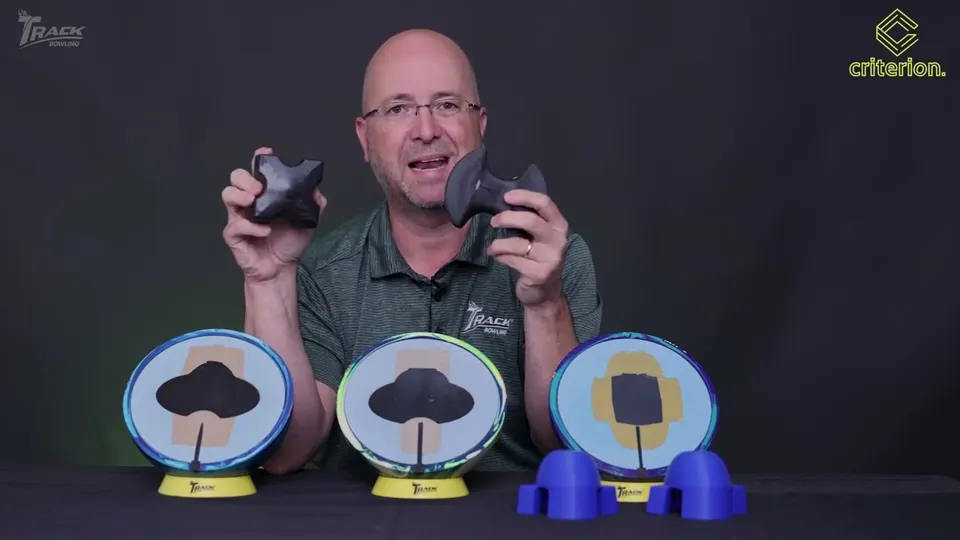
body which makes this a lower RG for the archetype made it narrower and taller and that helped raise the RG comparing the two in ball motion the archetype being a high RG ball was cleaner through the front and had a little more response at the back end of the lane now we're moving into the Criterion we did not use the exact same dense inner piece we started with a whole new piece as you see in this 3D printed model it is a greatly different design here we have
more of a bow tie shape and here we have designed this with an X the intent here is an asymmetrical interc cor versus symmetrical interc cor this piece is going to help us adjust asymmetry as well as RG and differential this piece is only going to adjust RG and differential the asymmetry of the core design will come from the main body itself so now let's dive deeper into the Criterion and how it compares to its predecessors the Paragon and the archetype now when we designed this ball
we wanted a ball that fit right in between in ball motion you had a low RG very strong rolling heavy oil ball the Paragon you had a still very strong ball in the archetype but it was a higher RG version so helped get down the lane Criterion we want to fit right in the middle why did we not just use the exact same Core Design we used in the past well we want to evolutionize technology and move on to new designs and get there in different ways to create different motion on the lanes so what this new Criterion does is it uses a traditional
low RG Core Design but the piece in the middle like we have in the Paragon and the archetype this one is symmetrical but it's also a lighter density piece so like I said it allows us to use this low RG Core Design much smaller more centered core but we're able to achieve a little bit higher of an RG by using a denser material on the outside of the core what this does is it allows this low RG design to still spin up fast but it doesn't want to use up too much energy in the front because its
actual RG is 2.5 so now that we shared this information about the new Criterion and the new Core Design you're probably wondering what does this mean to you in your game what this means is we've created a ball that is a true heavy oil Ball but it's one that you can transition throughout the night with where a typical ball like a paragon or archetype might have been a freshh game one game two ball you always had to move out of these balls into something that was weaker some of those cleaners through the front and had better energy down Lane with the new shape of the Criterion and the lighter density piece
in the middle we've created a piece that you can start with you can bowl game one game two and you keep chasing in as Lanes break down the ball's still going to have the better continuation at the back end so that wraps up this episode of track cast talking to you about the core design of the new Criterion and how it compared to the Paragon and archetype for more information about the Criterion and as great track products make sure you visit us at track boo.com and as always make sure you follow us on our social media channels
Performance Analysis
Performance Analysis
Testing revealed that the Track Criterion delivers a balanced motion profile that bridges the gap between earlier heavy oil designs and cleaner-through-the-fronts performance. The ball’s new asymmetric core geometry (featuring a distinctive bow-tie shaped dense inner piece paired with a lighter-density intermediate body) produces a distinctive RG of 2.5 that allows the coverstock to engage lanes aggressively while maintaining smooth, controlled motion down the lane. Independent reviewers observed that this design philosophy yields a ball capable of handling medium-heavy oil conditions throughout an extended session, adapting as lane conditions break down rather than forcing the bowler to switch equipment early in the night.
What distinguishes the Criterion in practical lane conditions is its ability to spin up quickly without expending excessive energy in the front part of the lane. Testing showed the ball maintains strong continuation and backend motion even after lanes deteriorate, a characteristic that sets it apart from predecessors that typically required transition into weaker equipment by game two or three. The reactive pearl coverstock complements this core design by providing the traction needed in heavier oil, while the asymmetric architecture ensures consistent response through the mid-lane and into the pins.
Who Is This Ball For?
The Criterion is ideally suited for league and tournament bowlers who throw in medium-heavy oil conditions and prefer equipment that adapts throughout a longer session. Bowlers who traditionally found themselves forced to carry multiple heavy oil balls (starting with one for fresh lanes and transitioning to a second by mid-session) will appreciate the Criterion’s extended usability window. This ball works particularly well for players seeking a true workhorse that can be chased up the boards as conditions evolve without sacrificing backend reaction.
This is also a smart choice for bowlers who value technological innovation and want equipment engineered specifically to reduce the need for mid-match transitions. The Criterion rewards bowlers comfortable moving their breakpoint as lanes develop, making it an excellent option for those who view equipment management as part of their competitive strategy rather than a limitation.
The Pros
- • Strong asymmetric core provides excellent angular motion
- • Super Response HK22 Pearl coverstock reads the midlane well
- • Impressive 4-5 inch flare potential for maximum entry angle
The Cons
- • May be too much ball for lighter oil conditions
- • Premium price point limits accessibility for budget-conscious bowlers
Who Is This Ball For?
The Track Criterion delivers premium asymmetric power with maximum backend punch on medium to heavy oil for tournament-level bowlers. Video reviews inside.
Technical Specifications
How It Compares


More Videos (4)

Track Criterion | Dave Klaas
Track Bowling
Track Criterion | Drew Klingler
Track Bowling
Track Criterion | Brandon Tarabek
Track Bowling
Track Criterion | Brandon Tarabek
Track BowlingFrequently Asked Questions
What oil condition is the Track Criterion best for?
Is the Track Criterion good for beginners?
What is the RG and differential of the Track Criterion?
How much does the Track Criterion cost?
What type of bowler should use the Track Criterion?
Explore More Reviews
Other Medium-Heavy Oil Balls



More from Track


Similar Price Range


Never Miss a Release
Join serious bowlers getting the weekly data dump on new ball releases and performance data.