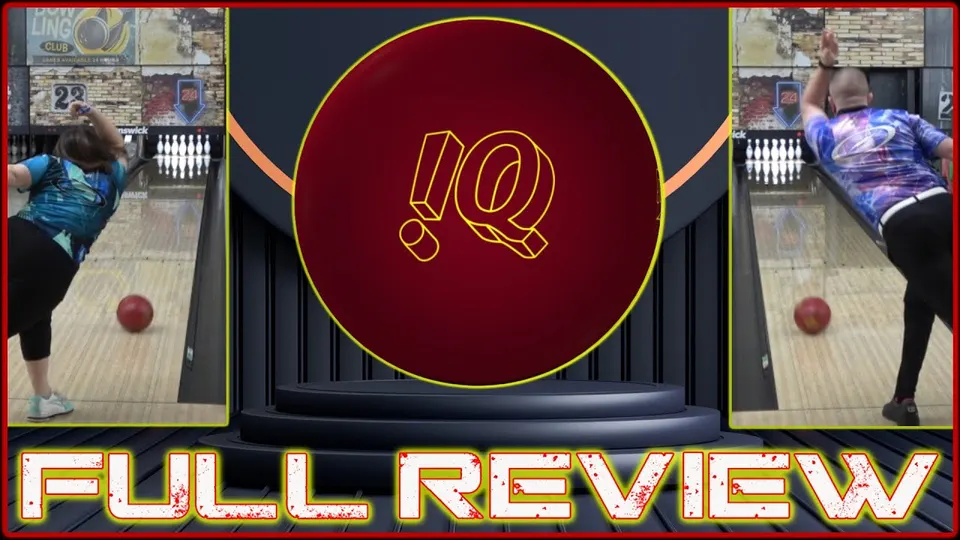
Storm IQ Tour 78/U Review
Storm's premium urethane: more hook potential than the Pitch Black with the 78D formula at 500 grit. $159.95. Video inside.
hello and welcome to our storm IQ tour 78u review the IQ 78 as it's being called for short releases on December 15th with the newly announced 900 Global Sublime by the way and is the new default SPI urethane option for those that bowl PBA competitions due to the rule changes there are a surprising number of things to talk about from a surprising number of angles so we pop this red pill in and we're going to see how deep the rabbit hole goes and whether or not you should be interested in one even if you don't bowl PBA tournaments before before we get started
the obligatory business big shout out and thanks as always to Royal Crest Lanes they're a big part of bringing these videos to you all it takes is a text and we have everything we need also my code Rose doll 10 will get you 10% off your order at checkout at coolwick and if you check the description you'll find a bunch of helpful links and information including our personal specs a discount code for custom ball cups and Spinners through scar prints a discount code for a new affiliation with free Spirits which is a non-alcoholic replacement brand and finally a link to pick up anything you may need at bowlersmart I do receive a a 5% Commission on all sales through the link
we're on the Kagel chromium Lane condition as usual it's a challenge pattern at just under a 7 to1 ratio 42 ft long 25 1/2 Ms it's a heavy side of medium for both volume and length it's not as easy as a house shot but not as punishing as a sport pattern the details for this one are fairly short and sweet the new PBA hardness rule as it affects urethane balls is that they all have to be manufactured at or over 78 hardness and stay above 73 hardness this means that the pitch black is no longer allowed for PBA National stops or
regionals same with the purple hammer for the B7 staffers that's why they now have the new blue hammer and we have the IQ 78 the story on this ball is that the control solid urethane cover from the pitch black was adjusted up to 78 hardness I'd have to believe that they slightly tinkered with the formula to Beef It Up a little as well uh but I don't know for sure and it comes at 500 grit out of the box that's a pretty standard surface for your urethane and of course features the centripetal C3 core from the IQ Tour series which comes
in at a 249 RG and an 029 differential in 15 lbs the low RG low diff core creates an early and strong role while the differential is right at the point where with most layouts it flares enough to get oil ring separation but not enough to get much which makes it stable and controllable this urethane cover is very akin to traditional urethane meaning it gets traction early and is very low response so it's extremely smooth and controllable the point of urethane is to get traction early on
difficult conditions and be the ultimate in control to help keep you in the pocket when they're hard I'm going to bounce back and forth on explaining things and talking ball reaction so bear with me but to set it up for Angel first she's always our control tester so everything gets the same layout and starts at the same surface to establish a benchmark we did indeed take it up to the reactor scuff finish so you can get an idea how different this ball is from other balls if you're newer to bowling and for those of you who know what you're looking at to give you an idea of the actual cover strength or traction
because everything under the Sun is going to hook at 500 grit later we do take the ball back down to 500 and move her around on the lane plus I have a lengthy testing session to take a look at a few specific things so stick around because this is going to be all over the place and you need to watch it all to understand the whole picture plus this obviously looks really bad and this isn't how it stays the big deal with hardness is that once a ball drops below a certain level or gets soft enough the footprint of the ball or where the ball touches the lane significantly increases
which increases the amount of surface area of the ball that's in contact with the lane which creates more traction more hook more control more stability Etc it increases the performance of the ball to the point that it ignores the lane conditions to a certain extent or makes difficult conditions much easier than they're intended to be Ron hickland who is CEO of creating the difference has an amazing video about this on their Channel which I would highly recommend you checking out to fully understand the topic I do have a Linked In the description there's been a lot of issues
and a lot of action taken against specific balls uh that have failed hardness tests over the last couple years to the point where the hardness floor for reactive balls has been raised slightly to 73 by both uh USBC and the PBA while the PBA only has raised the hardness floor for urethane balls to 78 I'm not going to go through all the rules because this is supposed to be a ball review but I would encourage you to also educate yourself in that direction so that you understand the point of this ball in the first place now uh back to
the point a harder cover means less of all those things I mentioned before less traction less hook less control less stability so on and so forth uh there is still a point to having urethane even nerfed on incredibly tough conditions and shorter heavier patterns reactive balls on certain patterns can be too aggressive and respond responsive and create a nightmare presenting an unrealistic challenge that requires a virtually unattainable and unfair level of performance from the bowler we have balls that go long and snap balls that
are early and smooth balls that are really strong and balls that are really weak so it's only natural that there would be a tool for this situation as well so enter urethane to Pivot to the ball reaction for a moment this ball is obviously not designed to be given any kind of room or angle or cover any boards and certainly not with a smoother surface reactive balls look just fine from here as I'm showing right now with her IQ T solid to illustrate the difference but this isn't what the iq7 was designed for and uh it will not succeed if used in
this way so we gave it a good scrubbing with a 500 pad to get it back to the Box surface started moving her right and tried it again as the more experienced viewer will understand here in a minute once she eventually gets to going straight up around five board and uses the ball in the manner for which it was designed it starts looking pretty decent I wanted to show all of this though because it's important to me that you know what you're buying and especially for the more inexperienced viewer how it should be used because it is quite different from typical reactive balls in addition to other urethane such as the
purple Hammer new blue hammer and even somewhat from the pitch black that I'll have as a comparison later in the video the next thing to point out is that as you may have noticed the IQ tour solid looked just fine it sailed down the lane and popped firmly into the pocket we filmed it after filming the i78 to hit the next talking point which is that urethane does not cause carryown lack of flare does a ball that flares or that has separation between the oil rings on the ball cannot cause carry down because
it doesn't ever roll over the same oil tracks again so how would it put the oil back on the lane even if it's urethane the reason that urethane got associated with carryown in the first place is that traditional urethane generally has weaker cores that do not flare so the ball continues to roll over the same oil tracks all the way down the lane so it picks the oil up in the front part of the lane and then when it hits the dry Lane on the back end it's still rolling over the same oil tracks so all that oil on the Surface starts to get deposited back onto the lane on the back end
that's part of the way traditional urethane is designed to work though it's a part of helping to create the control that urethane is used for in the first place urethane is also used with a lot of surface so that helps it pick up strong early and then since it continues to roll over the same oil tracks that tames down the reaction in the mid lane and backend to prevent it from continuing to hook as much or respond too sharply when it hits the back part of the lane as more and more carryown is created it just further AIDS the effectiveness of urethane because now
you have a very straight and consistent path to the pocket the wrinkle with the i78 is that the core is strong enough that it does flare some again given most typical layouts the point of a ball flaring is to expose fresh cover to the lane on every rotation that helps reactive balls do what they do they continue to get consistent traction throughout the front and middle part of the lane and then when they hit the back end since they're not still rolling over the same oil tracks there's fresh dry cover to help the ball turn more sharply on the back end to deliver more impact
at the pins this is also the point of reactive balls absorbing oil to help keep the cover fresh dry and tacky which traditional urethane does not do and which the cover on the i78 also does not do when the conditions aren't as tough and you don't have to worry so much about being accurate having a reactive ball that flares and absorbs oil is a real benefit but when the conditions are tough more Dynamic ball reaction can cause problems because if you get them a little outside the extra oil out there prevents them from hooking and if you get them in a little bit they hook too
soon and or too much because there's less oil on the inside of the lane the initial concern with this ball is that low RG urethane has historically not been great because like I explained a minute ago you want urethane to pick up strong or dig in the front part of the lane and then as oil gets on the cover to smoothly and gradually walk up to the pocket this ball is at 500 grit now and it's flaring so instead of dry cover just seeing the first 15ish feet of the lane dry cover is now seeing the entire
length of the lane in addition to that this core is very low RG which gets the ball rolling even earlier and more strongly urethane balls typically have very high RGS which helps offset how early the cover gets traction so a lower RG in addition to flare typically throws off the balance of the desired urethane reaction it makes the reaction much too early and strong in the front part of the lane and much too weak in slow down lanane while Angel has gotten lined up and the ball reaction has improved
significantly it doesn't take much of a Mist to get the ball offline if she lay lays it down a bit too far right gets arounded a little too much gets too far up the back of it throws it too hard too slow Etc it changes the reaction just enough that it causes issues at the pocket some of these shots look absolutely perfect and they're exactly what you want out of urethane and exactly the idea of this ball the problem is that more traditional urethane like the pitch black is more consistent and more forgiving the front to back traction and friction response
of this one is off just enough that it causes problems now at the same time I think this means that on certain conditions specifically heavier and shorter patterns this ball might even be more effective than the pitch black because it's going to dig and roll earlier and more strongly and still really control the backend part of the lane also because this ball doesn't cause carry down it might subtly adjust the shape to even be an improvement over the PB in some cases switching to the left side of the lane where urethane
sees more use we'll explore the other wrinkles now first of all yes I'm wearing a light blue and pink jersey with a pink undershirt and black and pink socks to film for a red bowling ball my sincere apologies for the oversight but it's not quite as much of a mistake as Sharon's pie thanks Marie calendar the first couple shots are for the memes every time out with a fresh dry chalky urethane cover the first few dig in instantly and almost Hook off the lane if you do plan on using urethane at
any point in a set throwing some shots to get get some oil on the cover during practice to settle it down is important again traditional urethane doesn't absorb oil so that's yet another part of creating desired urethane reaction now back to the point that I was making a minute ago strong core traditional urethane cover balls have typically been like the hot cell they get an immense amount of traction in Hook in the first 30 ft of the lane and then just die or give up down Lane traditional urethane
balls period like the pitch black have their reaction spread uh throughout the entire length of the lane to further enhance the control balls like this again hook very hard and very early and then tend to fade now the reason that they use this core is that raising the hardness of the cover 278 is significantly reducing the traction and strength which throws off the balance of the reaction in a different direction if they'd have just for example made a PBA specific version of the pitch black by
just making the cover harder on that same core it would have been a marble meaning it wouldn't have done very much at all very weak core now a significantly harder and weaker cover and they would have just been making a mix at that point the idea behind using this core is to help make up the difference in the harder cover and try to restore that balance that's necessary for the desired traditional urethane reaction I was very skeptical because again while I don't mind the lower RG helping the ball roll earlier the flare
specifically is something that was going to throw this out of whack but upon throwing the ball they got really close and it's quite a bit better than I expected now based on both experience with this type of ball before in addition to watching Angel uh the test for me was not going to be fresh cover on Fresh Lane that was obviously going to be a home run this is basically a stronger rolling pitch black on the fresh from right up the rail there wasn't going to be any problems there the issues were going to show up once the heads started to burn and I was either forced to Loft over them which
I'm absolutely terrible at throw it harder not really great at that either uh move in and slow speed down to cover some boards parallel move in or basically move everything inside so that I could still keep the ball in front of me uh that's where I expected the issues to be and that's where the issues were indeed it is very very important to keep this ball in front of you as long as you have fresh heads I'm surprised at how good the significantly harder cover is still performing I'm however not
surprised at how it does everything in the first 30 ft of the lane and then Fades the last 30 the point I made earlier about the pitch black having its reaction spread throughout the entire length of the lane will be even more starkly Illustrated here in a minute after I threw a couple games when the ball started to hook too early I tried a bunch of different things I tried bending a little just giving it a couple board swing I tried straightening out getting softer with my hand Slow Rolling it all kinds of things that we'll continue to watch over the next several minutes because I was trying to be as
thorough as possible within this window speaking of that I realized that I'm going to get the questions so I'll just address them now maybe it would look better on a different pattern you should have been on a short heavy pattern well if the flare is a problem why didn't you drill it different Etc the point of a review is comparison because your game is different your conditions are different the ball won't do exactly for you what it does for us but if we are consistent with our layout surfaces and conditions you can develop a consistent correlation between the reaction that we
get and the reaction that you get maybe everything ends up being a little smoother for you than it is for us or quicker stronger weaker whatever that way you can see what we get and know which direction to go for you if we instead match a layout to the ball say we drill weaker balls stronger stronger balls weaker put out more oil for stronger balls and less for weaker balls all we're doing is homogenizing the ball reaction action everything would look the same and you'd have no idea what the reason for the reaction differences between the balls was I used to work in
a ferally funded testing lab and it's crucial to have controls or benchmarks set up to measure test results against in our reviews uh the points of control are the same layouts same surfaces same Lane conditions even the exact same Lane most of the time so you can see the differences in the balls because that's one of the few things you can actually get out of a ball review I can't and wouldn't if I could drill a case of these with different layouts and surfaces and get video for them on 10 different patterns having a known
Benchmark set of conditions to test in just like having a benchmark ball in your bag tells me which direction we need to go so that I can expand on that in the review and so you can see what I'm seeing and why I think what I do traditional urethane is typically used on shorter heavier patterns but has also been used on medium and even some long ones when angle control is necessary or helpful this specific pattern is right in the middle of everything plus everything looks about as good on this as it's going to it's enough volume for
the strong stuff but not too much for the weak stuff and it's also something you'd possibly use urethane on and that urethane of all kinds reacts well and true on most importantly it also helps me figure out what the ball needs and what it likes to do so I don't need to find a shorter heavier pattern to tell me this ball needs a shorter heavier pattern to be at its best plus this also gives me an idea of if it would look good on longer patterns too which of course a shorter heavier pattern wouldn't basically this pattern gives me all kinds of information rather than
specific end or isolated experience now when it comes to the layout the benefit of this core is that it can be drilled more weakly to raise the RG drop the differential and reduce the flare enough to make it more like traditional urethane but the vast majority of people are going to put a quote unquote normal layout on the ball and try to use it like they'd use a pitch black so this is why we did what we did I drilled this ball exactly like I drilled my pitch black which is exactly how I drilled my zenu which is exactly how I drill most
of my IQs Etc to show you what you're going to get from doing that speaking of the pitch black now that we've seen what we needed to see here let's go to that comparison and try to put a bow on this thing little joke here to start out I had a thought when I was done filming with the IQ with my my ice aging and near needing to be replaced I thought why not take a look it looked pretty sharp and it save a spot in my bag at Nationals where let's be honest I'm just going to put another urethane ball anyway moving on we all know about the
pitch black if you're a urethane user you've had one it's the premier traditional urethane option on the market has been for several years now and it still will be outside of PBA competition now I don't want to hear but the purple Hammer because it's a different kind of urethane neither ball is trying to be or compete with the other you'll notice very similar things between the PB and i78 right away tons of early dig really smooth down Lane and with a stronger layout on this ball it also flares a very tiny bit but also has
very long bow ties a bow tie is where the oil tracks cross each other on the top and bottom of the ball so it's almost the perfect Zone where it's half and half it's not a dead static track where the ball rolls over the same oil tracks all the way down the lane but but not quite to the point where there's a lot of fresh cover seeing the lane on every rotation like there is with the i78 a little consistent dig throughout the lane with a little consistent stability so it's a nice blend as soon as some oil gets onto the cover and it settles into usable territory you see
some of the same things you're going to have some nasty flat hits with urethane on occasion that's just going to happen but the main thing we're going to dive into and the main difference is that once the pitch black gets traction and stabilizes it then has a continuous slow climbing Arc the rest of the way down the lane the i78 was dig dig dig fade but the pitch black is dig dig walk walk so it's not giving up it's not getting too much traction in the fronts or doing too little down Lane this keeps it from being extra flat or pukey down Lane this
also means that as I continue to adjust I can straighten up and get on top of the friction without it being too crazy or too early but I can also move in and bend it a bit because it's not doing everything it's it's going to do in the first 30 ft it's not giving up or fading so you can see that while the ball paths in shot shapes actually are remarkably similar what I said earlier about the reaction of the pitch black being spread throughout the entire Lane this is what that looks like and you can see kind of the chain reaction of what the
differences cause the pitch black isn't moving any more sharply or strongly into the pocket it's just because the ball isn't limping to the finish line there's a lot more pocket presence there's Seven's getting kicked six is getting tripped and light hits going down that weren't with the IQ 78 to finally reach a conclusion here as we watch the rest of this like I said I don't know 15 minutes ago by now the i78 is really close it's quite a bit closer than I expected it's not exactly the PB though
and I'm not entirely sure it was intending to be Hammer's new blue isn't exactly the purple Hammer either but again not sure it was intending to be the IQ 78 I think will actually be better better than the Pitch Black in some situations but the question is going to be tinkering with layouts and Surface Prep to try to get it to see the lane the right way front to back so that it'll in turn get through the pins the right way more often and more consistently I think the way I'm seeing it right now the pitch black is still the more versatile more usable option
that will be more effective in more situations which of course isn't a shock the PBA didn't give the companies much time at all to get anything developed the rule takes effect at the start of this season in January 2024 and they just put the new rules out in March or April that's not much time to get something done when you're still busy with regular R&D and production on everything else in the different lines so the fact that we got this good of an option this quickly has to be applauded and again this is more of a specific answer for our staffers on tour this
doesn't mean that you can't use it but it also doesn't mean that you have to use it the pitch black isn't going anywhere so if you're not on tour this really doesn't affect you but at the same time this also doesn't mean you can't pick one of these up and use it if you like what you see ultimately though in my opinion I now definitely watch other videos and get other people's thoughts on this but in my opinion unless you're an SPI staffer bowling in PBA tournaments the pitch black for me Still Remains the standard I'm not kidding with spare ball reference either
that's actually going to be a thing but mostly because if I just take an ice that's all it's good for but if I put the ice q78 in there it'll be there for those situations where it's the look over the pitch black my default for traditional urethane will be the pitch black but I still want to have this ball in the bag so it's a kill two birds with one stone type of deal and of course I'll have a report card for this one in a couple months and I do have some tournaments between now and then that it's absolutely traveling to so I'll have more information for you then once again the I tour 78u will be released on
December 15th with the newly announced Sublime from 00 Global of course down in the description is a link to Bowlers Mart that will get either of those balls ordered for you and of course don't forget my code Rose doll 10 to get 10% off your order at checkout at coolwick thanks for watching and may the strikes be with [Music] you
Performance Analysis
Performance Analysis
Testing on the Kagel chromium challenge pattern revealed that the IQ Tour 78/U presents a distinctly different urethane profile than traditional urethane offerings. The ball’s upgraded hardness formula maintains early traction characteristic of urethane, but the low RG core (249 RG, .029 differential) produces earlier and more aggressive roll than legacy urethane designs. At box surface (500 grit), independent reviewers observed that the ball’s combination of early core motion and flare capability creates a traction curve that demands precision: shots executed within the intended line and release window produced excellent pocket reaction, but small misses in either direction resulted in inconsistent pin action. This represents a meaningful departure from more forgiving urethane balls like the Pitch Black, where the front-to-back traction transition remains more consistent across varied release conditions.
The hardness increase to 78 (required under new PBA regulations) does reduce overall hook and control compared to softer urethane, but testing showed this trade-off serves a specific purpose: on heavy oil patterns and shorter oil volumes where reactive balls become overly dynamic and create unrealistic challenge, this ball delivers the controlled motion urethane is designed for. Notably, testing confirmed that the IQ Tour 78/U does not cause carry-down: the core is strong enough to produce flare, meaning the ball exposes fresh cover throughout the lane rather than rolling over identical oil tracks. When moved to rougher surface finishes and adjusted across different board angles, the ball responded predictably, though reviewers consistently noted it rewards precision more heavily than traditional urethane alternatives.
Who Is This Ball For?
The IQ Tour 78/U is purpose-built for bowlers competing in PBA-sanctioned events where the new hardness floor has eliminated older urethane options, or for league and tournament bowlers who face exceptionally heavy oil patterns where reactive equipment becomes problematic. This ball suits bowlers with solid fundamentals and consistency in release: those who can repeat their shot shape reliably will find the early traction and controlled backend response exactly what they’re looking for. It’s an excellent choice for anyone needing to combat skiddy, overly responsive ball motion on short, heavily oiled patterns.
This is not an ideal first urethane for bowlers still developing their release accuracy, nor should it be selected simply as a “control” ball for medium oil conditions where more forgiving reactive equipment would serve better. Bowlers considering the IQ Tour 78/U should evaluate whether they regularly face the specific lane conditions it’s engineered to handle: if your typical shot requires angle and room, or if you bowl primarily house shots, a traditional reactive ball or softer urethane will prove more versatile and user-friendly.
The Pros
- • Premium urethane with more hook than the Pitch Black
- • C3 core provides more midlane read than basic urethane
- • 78D hardness rating for consistent, predictable motion
- • 500 grit OOB gives immediate traction
The Cons
- • Not as versatile as reactive options on heavier oil
- • Higher price than the Pitch Black for a urethane ball
Who Is This Ball For?
Storm's premium urethane: more hook potential than the Pitch Black with the 78D formula at 500 grit. $159.95. Video inside.
Technical Specifications
How It Compares

More Videos (3)

iQ Tour 78/U CloserLook | Storm Bowling
Storm Bowling Products Inc.
Storm IQ Tour 78-U | Urethane is Here to Stay | The Hype
The Hype
Storm IQ Tour 78/U Bowling Ball Review | Multiple Styles and Testers
BowlersMartVerified Bowler Reviews (94 reviews, 4.9/5 avg)
Bowlers Say
Bowlers say the IQ Tour 78/U provides controlled, predictable urethane reaction with the proven C3 core compensating for the harder 78 hardness coverstock. Most effective on short sport patterns and fresh conditions where control is needed. Compared to Pitch Black, it's cleaner through fronts but still maintains traditional urethane shape.
AI summary of 94 verified purchase reviews
Bowlers frequently mention:
Dual Angle Layout: 60 x 5 x 40 Storm Vector Layout: 5 x 4 ¾ x 2 ¾ This ball has that controlled, early urethane reaction with the hardness compliance of the PBA tour in 2024. Very smooth predictable reaction which is very comparable to the Pitch Black.
With the PBAs new urethane rule that start the beginning of 2024, it was only a matter of time before Storm came out with something. Introducing the iQ Tour 78U, the ball features the iconic C3 core that has been in the iQ Tour for over 10 years and the new Controll 78 Urethane solid cover. This ball comes out of the box pretty dull with 500 grit finish to help with the added hardness and with the lower RG in the core I expected it to be way different than anything else SPI has created with urethane. I drilled mine like my favorite Fast Pitch, 5.5 x 1 and man I am super excited to have this ball in my bag. This ball is easy 4-5 boards of more overall hook than my Fast Pitch was so I believe I can use this on patterns with more volume and even a couple feet longer. It still gives me that typical urethane shape even with the hardness being higher. If you are in the market for an new urethane ball, look no farther than the iQ Tour 78U.
Hey everyone, I'm back with another ball review, and this time it's for the Storm !Q Tour 78-U. In 14 pounds this ball is wrapped in the Controll 78 Solid Urethane Cover and has the C³ Centripetal Control and has an RG of 2.54, Diff of .034. The layout for this ball is 4x4x2 Urethane…..I am not sure that a piece of raw material has changed and divided a sport or industry as much as urethane has. No matter what side of the fence you are on it is here and doesn't seem to be going anywhere soon. I honestly can attest that this is not a ball that I will use a lot and that is not because it is bad, but the fact is that controlled urethane reaction is best suited for those with a much higher rev rate then mine. With proper urethane reaction it has an early hook and stays continuous but for me I saw it as early due to the 500 grit surface and the ball burned up/rolled out. Standing on 20 and trying to “hook” it just had the ball roll out and I could move all the way right and throw it directly at the pocket but the ball hit very light. For me and low rev guys that can not get that urethane reaction can rely on a weaker ball like a Storm Tropical Surge or a Roto Grip Hustle. My best suggestion as always is to find a Matchmaker Live to throw the new balls and talk with the Pro Shop and/or Pro that is there on what ball is best for you. Check us out on YouTube at https://www.youtube.com/onefrombills Get out to your STORM VIP shop or Pro Shop and get yours today! BOWLER STYLE: RH - Power Stroker Rev Rate: 320 Ball Speed: 15-16 PAP: 4 7/8 right 3/8 up. #Storm #VISE #BowlersChoiceProShop #BabesAndBallsBowling #LogoInfusion or #IAmBowling (coupon code HIRSCH 20% off at checkout)
The all new !Q 78/U is Storm’s newest urethane ball in response to USBC Hardness rule being put in place. This ball is everything that I would have expected out of it, it is strong, slow, and reads the front of the lanes well. I am pleasantly surprised with what I have seen so far, with the harder cover I was worried that it would never hook. However, the R&D at storm did a good job putting a stronger core in this ball to combat this issue. From what I have seen so far, I would suggest drilling this ball with a weaker VAL angle (25-35 degrees) than a “traditional urethane” layout (0-10 degrees) to help the ball continue more downlane. I have seen a few other staffers drill the 78/U with a 10 degree VAL and it looked good, however, it looked like they were forced to have extremely tight angles in order to get optimum carry. With a weaker VAL, I am able to see more downlane shape so I can keep the ball in front of me and I can also move in and open up my angles a bit without sacrificing pin carry. All in all, I think that storm did a great job in such a short amount of time to combat the new PBA hardness rule changes. Go out and get yours December 15th at your local SPI proshop! Layout: Dual Angle: 45 x 4½ x 35 Vector: 4½ x 4 x 2¼
The all new !Q 78/U is Storm’s newest urethane ball in response to USBC Hardness rule being put in place. This ball is everything that I would have expected out of it, it is strong, slow, and reads the front of the lanes well. I am pleasantly surprised with what I have seen so far, with the harder cover I was worried that it would never hook. However, the R&D at storm did a good job putting a stronger core in this ball to combat this issue. From what I have seen so far, I would suggest drilling this ball with a weaker VAL angle (25-35 degrees) than a “traditional urethane” layout (0-10 degrees) to help the ball continue more downlane. I have seen a few other staffers drill the 78/U with a 10 degree VAL and it looked good, however, it looked like they were forced to have extremely tight angles in order to get optimum carry. With a weaker VAL, I am able to see more downlane shape so I can keep the ball in front of me and I can also move in and open up my angles a bit without sacrificing pin carry. All in all, I think that storm did a great job in such a short amount of time to combat the new PBA hardness rule changes. Go out and get yours December 15th at your local SPI proshop! Layout: Dual Angle: 45 x 4½ x 35 Vector: 4½ x 4 x 2¼
Showing 1–5 of 49 verified reviews
Frequently Asked Questions
What oil condition is the Storm IQ Tour 78/U best for?
Is the Storm IQ Tour 78/U good for beginners?
What is the RG and differential of the Storm IQ Tour 78/U?
How much does the Storm IQ Tour 78/U cost?
What type of bowler should use the Storm IQ Tour 78/U?
Explore More Reviews
Other Medium-Light Oil Balls



More from Storm


Similar Price Range



Never Miss a Release
Join serious bowlers getting the weekly data dump on new ball releases and performance data.